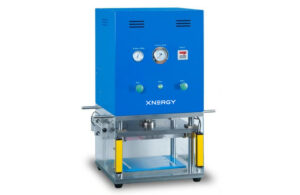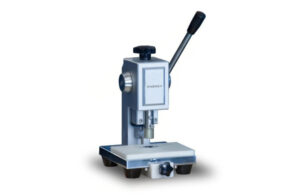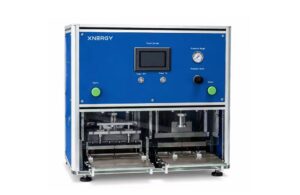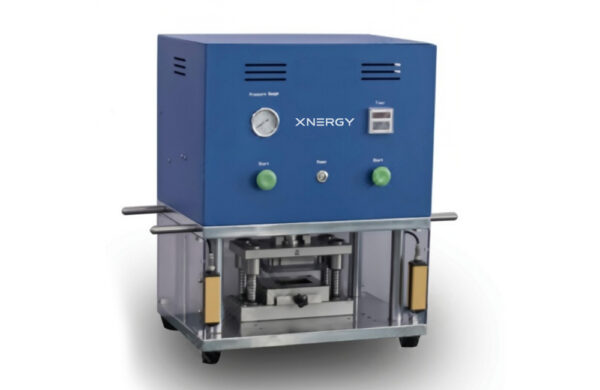
Precision Tool-Steel Electrode Die-Cutter XN-PDCM-150
SKU: XN-PDCM-150
Precision Tool-Steel Electrode Die-Cutter XN-PDCM-150 is a benchtop pneumatic die-cutter built around a matched male-female SKD11 tool-steel die set for the highest-quality lithium-ion battery electrode shaping. The matched-die geometry delivers burr ≤12 μm with no edge collapse, supporting cell formats sensitive to edge quality.
Die life ≥1,000,000 cuts under normal use with 10 re-sharpening cycles, max cut size 120 × 100 mm, infrared positioning, light-curtain + dual-button safety actuation.
Need a bulk order or custom specification? Request a competitive quote today!
Name: Precision Tool-Steel Electrode Die-Cutter XN-PDCM-150
Equipment Type: Benchtop Precision Pneumatic Die-Cutter with SKD11 Tool-Steel Matched Tooling
Product Code: XN-PDCM-150
Brand: Xnergy
Product Introduction:
Precision Tool-Steel Electrode Die-Cutter XN-PDCM-150 is a benchtop pneumatic die-cutter built around a matched male-female SKD11 tool-steel die set, designed for the highest-quality electrode shaping where edge integrity matters more than throughput. Pre-cut lithium-ion battery cathode and anode sheets are positioned by an infrared sensor on the lower die, and a pneumatic cylinder drives the upper die into precise engagement with the lower die — the matched-tooling action delivers a burr level ≤12 μm with no edge collapse, and a die life of over 1,000,000 cuts with 10 re-sharpening cycles. The unit suits R&D and small-batch electrode preparation for high-end pouch cells, prismatic cells, and quality-sensitive electrochemical studies.
Working Principle:
Place pre-cut electrode sheets onto the lower die plate, aligned via the infrared positioning system. Press both safety-actuation buttons simultaneously. The pneumatic cylinder drives the upper male die down into the lower female die, shearing the electrode with matched-tooling action. Remove the finished part to complete the cycle.
Key Features:
SKD11 tool-steel matched male-female die — precision-ground cutting edges
Burr ≤ 12 μm with no edge collapse — suitable for edge-quality-sensitive cell formats
Long die life — over 1,000,000 cuts under normal use
Die can be re-sharpened up to 10 times to extend usable life
Stable cut size across the full die life
Custom die geometry for any electrode shape — including pouch- and prismatic-cell shapes
Maximum cut size 120 × 100 mm, custom-specified per die
Precision guide system for vertical accuracy
Infrared sheet-positioning system for accurate sheet-to-die alignment
Safety light curtain at feed entry + dual-button actuation
Quick and easy die changeover
Technical Specifications:
| Parameter | Specification |
|---|---|
| Die Type | Matched male-female precision die set |
| Die Material | SKD11 tool steel |
| Drive | Pneumatic cylinder |
| Actuation | Dual-button start (two-hand safety) |
| Positioning | Infrared sheet-to-die alignment |
| Maximum Cut Size | 120 × 100 mm — customizable per die |
| Burr Level | ≤ 12 μm, no edge collapse |
| Die Life | ≥ 1,000,000 cuts (normal use, with controlled burr) |
| Re-Sharpening | Up to 10 cycles |
| Cutting Force | Max. 300 kg (pneumatic cylinder) |
| Die-Cut Stroke | 40 mm |
| Throughput | 5 cuts/min |
| Safety | Safety light curtain + dual-button actuation |
| Compressed Air Requirement | 0.5 – 0.8 MPa |
| Power Supply | Configurable according to local electrical standards |
| Rated Power | 0.1 kW |
| Dimensions (L × W × H) | 480 × 420 × 630 mm |
| Weight | 100 kg |
Application Areas:
XN-PDCM-150 is suitable for:
High-precision die-cutting of lithium-ion battery cathode and anode sheets where edge quality is critical
R&D and small-batch electrode preparation for high-end pouch and prismatic cells
Electrochemical studies where electrode edge integrity affects cycling and impedance results
Long-running studies where consistent cut quality across many electrodes is required
Maintenance:
Clean the equipment and the die regularly with a soft cloth lightly moistened with alcohol
Lubricate moving parts periodically to ensure smooth operation
If the equipment is not used for an extended period, clean the moving surfaces and apply a protective anti-rust coating
Periodically inspect screws, nuts, pins, and other fasteners to prevent loosening
Re-sharpen the SKD11 die as needed to maintain burr specification (up to 10 cycles available)
Safety Notes:
Do not bypass the safety light curtain or dual-button operation
Do not place hands or other body parts in the die work area during operation
Operation should be performed by a single trained operator
Disassembly should only be performed by qualified technicians
Ensure compressed air supply is stable within the specified range before operation
Specifications are provided for reference. Custom die tooling and shapes are specified at order time. Die life and re-sharpening capability depend on the operating conditions and die maintenance.
Note: Specifications listed above are typical and for reference only. Actual die-cutting performance depends on electrode sheet thickness, coating composition, die condition, and air-supply stability. XN-PDCM-150 occupies a distinct position in Xnergy’s die-cutter range — its value is not throughput but edge quality and die longevity. The matched SKD11 tool-steel die set delivers ≤12 μm burr with no edge collapse and a die life of over a million cuts (33× the life of conventional dies) with up to 10 re-sharpening cycles, making the total cost-per-cut substantially lower for long-running studies where edge integrity drives result quality. Choose XN-PDCM-150 when electrochemical results are sensitive to electrode edge condition, or when the same die geometry will be cut hundreds of thousands of times across the program. For high-throughput production where ≤15 μm burr and 30,000-cut die life are acceptable, the XN-PDC-280 and XN-PDC-350 semi-automatic die-cutters move at 800–2000 pcs/h. For glovebox-compatible single-stroke prototyping with no electrical components, see the XN-PDC-120. Upstream electrode sheets are typically produced via the Slot-Die Coating System XN-SDC. For active materials, see our Cathode Materials and Anode Materials catalogs.