
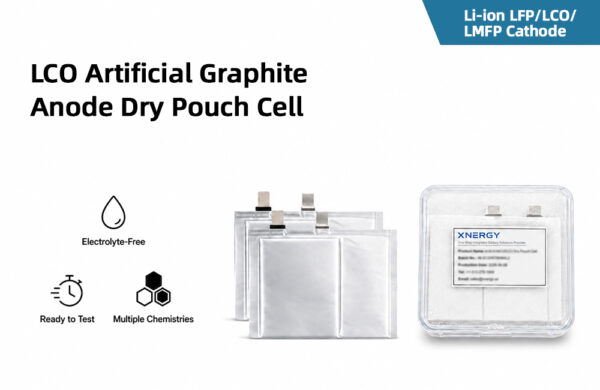
LCO Artificial Graphite Anode Dry Pouch Cell(Multiple Specs)
Free Shipping$102.00
LCO / Artificial Graphite Anode Pouch Dry Pouch Cell — high-voltage dry pouch cell pairing 4.4 V LCO cathode with artificial graphite anode. The classic consumer electronics chemistry, extended to high-voltage operation. Standard 1 Ah grade plus 2 Ah / 5 Ah grades. Ships unfilled for custom electrolyte and CEI research.
Need a bulk order or custom specification? Request a competitive quote today!
Name: LCO / Artificial Graphite Anode Pouch Dry Pouch Cell (Multiple Specs)
Cell Type: LCO-Graphite Pouch Dry Cell (4.4 V High-Voltage)
Product Code: XN-LCO-Gr
Description:
LCO / Artificial Graphite Anode Pouch Dry Pouch Cell pairs high-voltage lithium cobalt oxide (LCO) cathode with high-capacity artificial graphite anode in a fully assembled but unfilled (dry) pouch format. As a result, this configuration delivers the proven cycle stability and manufacturing maturity of the classic LCO/graphite chemistry — the workhorse of the consumer electronics industry — combined with the higher energy density unlocked by 4.4 V operation. Furthermore, the dry (unfilled) pouch format allows customers to inject their own electrolyte formulations, making this cell ideal for high-voltage electrolyte and additive research targeting smartphones, tablets, wearables, and other premium consumer electronics applications.
Application:
This dry pouch cell serves as a versatile research platform for consumer electronics battery development, including high-voltage electrolyte formulation studies (the cell ships unfilled, allowing customers to inject their own electrolyte), 4.4 V LCO cathode performance evaluation, additive screening for high-voltage CEI stability, full-cell prototyping for premium smartphones, tablets, drones, and wearables, and academic studies of LCO/graphite electrochemistry under high-voltage stress.
Cell Specifications (1 Ah Standard Grade):
| Parameter | Value |
|---|---|
| Cell Type | LCO-Graphite Pouch Dry Cell |
| Design Capacity | 1000 mAh (1 Ah) |
| Cell Dimensions | 6090 (60 × 90 mm) |
| Cell Architecture | Stacked (laminated) |
| Recommended Voltage Range | 3.0 – 4.4 V (high-voltage) |
| N/P Ratio | 1.1 |
| Separator | PE 9+3 (composite) |
| Cathode Sheet Count | 4 |
| Anode Sheet Count | 5 |
| Recommended Electrolyte Filling | 3 g/Ah |
| Recommended Aging | 45 °C, 24 h rest |
| Recommended Formation | Stepped multi-current protocol (see below) |
| Final Aging | 45 °C, 24 h rest |
Cathode Specifications (LCO):
| Parameter | Value |
|---|---|
| Active Material | LCO (Lithium Cobalt Oxide, high-voltage grade) |
| Active Material Content | 96.0% |
| Specific Capacity | 170 mAh/g (at 4.4 V) |
| Compaction Density | 3.4 g/cm³ |
| Double-Side Areal Density | 38 mg/cm² |
| Electrode Dimensions | 75 × 54 mm |
Anode Specifications (Artificial Graphite):
| Parameter | Value |
|---|---|
| Active Material | Artificial Graphite |
| Active Material Content | 96.0% |
| Specific Capacity | 350 mAh/g |
| Compaction Density | 1.3 g/cm³ |
| Double-Side Coating Areal Density | 19.4 mg/cm² |
| Electrode Dimensions | 77 × 56 mm |
Values measured by Xnergy. Typical values for reference; not guaranteed unless otherwise specified.
Available Capacity Grades:
| Grade | Capacity | Notes |
|---|---|---|
| 1 Ah Standard | 1000 mAh | 4.4 V high-voltage window, lab-scale R&D |
| 2 Ah | 2000 mAh | Mid-scale prototyping |
| 5 Ah | 5000 mAh | Pre-production validation |
| Custom Specs | — | Voltage window, separator, and electrode dimensions customizable; contact sales |
Characteristics:
4.4 V high-voltage operating window
Extended upper voltage limit to 4.4 V unlocks 170 mAh/g specific capacity from the LCO cathode — significantly higher than conventional 4.2 V LCO operation (~145 mAh/g). As a result, customers gain meaningful energy density improvement without changing electrode chemistry, ideal for high-voltage electrolyte and additive research targeting premium consumer electronics applications.
Mature, industry-standard LCO/graphite chemistry
The LCO + artificial graphite combination is the most extensively characterized lithium-ion chemistry, powering the consumer electronics industry for over two decades. Therefore, this cell provides a reliable benchmark with rich published reference data — ideal for studying how electrolyte additives or operating conditions deviate from the established baseline.
Stepped formation protocol for high-voltage CEI stability
The recommended formation uses a multi-step current protocol (0.1C → 0.2C → 0.6C across three voltage stages) rather than a single-step charge. Consequently, this gradual approach builds a more stable cathode-electrolyte interface (CEI) on LCO at 4.4 V, reducing first-cycle losses and improving long-term cycling stability — a critical practice for high-voltage LCO research.
Dry (unfilled) pouch design for electrolyte studies
The cell ships fully assembled but without electrolyte. Therefore, customers can inject their own electrolyte formulations to study high-voltage electrolyte stability, additive effects on CEI formation, and SEI behavior on graphite — critical capabilities for advancing LCO toward 4.5 V and beyond.
Standardized stacked pouch architecture
Stacked-electrode (laminated) construction with N/P ratio of 1.1 and PE 9+3 composite separator. Therefore, results are reproducible across labs and comparable with industry benchmarks for LCO/graphite cells.
Multiple capacity grades + custom specifications
Standard grades cover 1 Ah / 2 Ah / 5 Ah. Furthermore, custom voltage windows (4.2 V / 4.4 V / 4.45 V), alternative separators, and electrode dimensions are available on request to match specific research requirements.
Recommended Activation Protocol:
1. Inject electrolyte at 3 g/Ah ratio. 2. Vacuum-seal the pouch under inert atmosphere. 3. Aging: hold at 45 °C for 24 h. 4. Pre-formation rest: 5 minutes. 5. Stage 1: charge at 0.1C for 20 minutes, cutoff 3.2 V. 6. Rest 2 minutes. 7. Stage 2: charge at 0.2C for 30 minutes, cutoff 3.9 V. 8. Rest 2 minutes. 9. Stage 3: charge at 0.6C for 80 minutes, cutoff 4.4 V. 10. Final aging: hold at 45 °C for 24 h before subsequent cycling tests.
Packaging & Storage:
Cells ship vacuum-sealed under inert atmosphere in moisture-barrier packaging. Therefore, customers should store sealed in a cool, dry environment, protected from moisture. Open packaging in a dry-room or glovebox environment immediately before electrolyte filling.
Safety:
For research and industrial use only. Activated lithium-ion cells contain flammable electrolyte and high-energy electrode materials. Wear PPE during cell handling and electrolyte filling. Never short-circuit, overcharge, overdischarge, puncture, or expose cells to high temperatures (> 60 °C). High-voltage LCO operation at 4.4 V poses additional CEI degradation and oxygen release risks under thermal abuse; conduct all testing in well-ventilated, controlled environments. Refer to SDS for complete safety information.
Note: Values listed above are typical and for reference only. Performance may vary depending on electrolyte choice, formation protocol, cycling conditions, and test environment. See also other dry pouch cells in our catalog: LCO / Lithium Metal, NCM811 / Silicon-Carbon, NCM811 / Lithium Metal, NCM811 / Artificial Graphite, NCM811 Anode-Free, NCM90 / Silicon-Carbon, NCM90 / Lithium Metal, NCM622 / Artificial Graphite, NCM622 / Lithium Metal, NCM613 / Artificial Graphite, NCM523 / Lithium Metal, LFP / Artificial Graphite, LFP / Lithium Metal, LFP Anode-Free, and LMFP / Artificial Graphite. Browse the full Dry Pouch Cell category for all configurations.
| LCO / Graphite | (1ah) |
|---|
Related products
-
NCM90 Artificial Graphite Anode Dry Pouch Cell(Multiple Specs)
Free Shipping Price range: $102.00 through $115.00Select options This product has multiple variants. The options may be chosen on the product page -
SPAN Dry Pouch Cell (Lithium-Sulfur Research Cell)
-
NCM622 / Artificial Graphite Anode Pouch Dry Pouch Cell(Multiple Specs)
Free Shipping Price range: $89.00 through $115.00Select options This product has multiple variants. The options may be chosen on the product page -
NCM622 / Lithium Metal Pouch Battery Dry Pouch Cell (Unfilled)(Multiple Specs)
Free Shipping Price range: $165.00 through $292.00Select options This product has multiple variants. The options may be chosen on the product page