
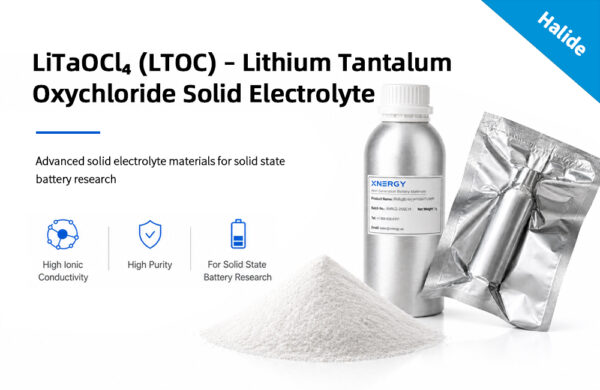
LiTaOCl₄ (LTOC) – Lithium Tantalum Oxychloride Solid Electrolyte
SKU: XN-LTOC-LO
Need a bulk order? Request a competitive quote today!
Name: LTOC Lithium Tantalum Oxychloride Solid Electrolyte (LiTaOCl₄)
Material Form: Powder
Product Code: XN-LTOC-LO
Description:
LiTaOCl₄ (LTOC) is a lithium-lean tantalum-based oxychloride solid-state electrolyte engineered for next-generation high-voltage all-solid-state lithium batteries (ASSLBs). Combining the high ionic conductivity of chloride electrolytes with the moisture stability benefits of oxide components, this composition delivers 6–8 mS/cm room-temperature ionic conductivity along with strong electrochemical stability against high-voltage cathodes. Furthermore, as part of Xnergy’s tantalum oxychloride family, LiTaOCl₄ offers an alternative stoichiometry to Li₂TaOCl₅ for studies requiring different lithium-content optimization.
Application:
This material serves as a high-conductivity catholyte for all-solid-state lithium batteries with high-voltage cathodes (LCO, NCM, Ni83). Especially suitable for sulfide-halide composite electrolyte architectures (paired with LPSC as anode-side separator), oxychloride electrolyte chemistry studies, room-temperature ASSB prototyping, and fundamental research on lithium-content effects in tantalum oxychlorides.
Specifications:
| Property | Value |
|---|---|
| Composition | LiTaOCl₄ |
| Ionic Conductivity | 6–8 mS/cm @ 28 °C |
| Crystal Structure | Tantalum oxychloride framework |
| Electrochemical Window | Stable vs high-voltage cathodes |
| Compatible Cathodes | LCO, NCM, Ni83 and other high-nickel systems |
| Form | Powder |
| Pack Sizes | 10 g / 25 g / 50 g (custom larger quantities available) |
| Storage | Inert atmosphere (Ar / N₂), sealed, moisture-excluded |
Values measured by Xnergy. Typical values for reference; not guaranteed unless otherwise specified.
Characteristics:
Ultra-high room-temperature conductivity
At 6–8 mS/cm at 28 °C, this material exceeds most halide electrolytes by an order of magnitude. Moreover, it matches or surpasses leading sulfide electrolytes (e.g., Li₆PS₅Cl ~5 mS/cm), without the cathode interface compatibility issues of sulfides.
High-voltage cathode compatibility
The oxychloride chemistry remains stable against high-voltage cathodes (LCO, NCM, Ni83). Therefore, no LiNbO₃ or other interface coatings are required, simplifying cell architecture and reducing cathode interface resistance.
Improved moisture tolerance vs sulfides
Compared with sulfide electrolytes (LPSC, LGPS), oxychloride LTOC tolerates brief ambient exposure significantly better. Consequently, this lowers the bar for laboratory handling and reduces process complexity in pilot-scale manufacturing.
Lithium-lean composition for tunable transport
The LiTaOCl₄ stoichiometry offers a lower lithium content compared to Li₂TaOCl₅ and Li₂TaOCl₆ variants. As a result, this enables systematic studies of how lithium content affects ionic transport, defect chemistry, and interfacial behavior in tantalum oxychloride systems.
Cold-pressable for room-temperature cell assembly
Reduced grain boundary resistance allows cold-pressed densification at room temperature without high-temperature sintering. Therefore, customers can quickly fabricate coin cells and pellet cells without specialized hot-pressing equipment.
Packaging & Storage:
The material ships vacuum-sealed under inert atmosphere in moisture-barrier aluminum-laminated bags. Therefore, customers should store it sealed in Ar or N₂ glovebox, protected from moisture. Standard pack sizes are 10 g, 25 g, and 50 g; larger custom quantities are available on request. While the material offers better moisture tolerance than sulfides, brief air exposure should still be avoided to preserve ionic conductivity.
Safety:
For research and industrial use only. Wear PPE (gloves, masks, safety goggles). Refer to SDS for complete safety information.
Note: Values listed above are typical and for reference only. Performance may vary depending on cell architecture, cathode selection, electrolyte separator, and test protocol. See also our other tantalum oxychloride variants: LTOC (Li₂TaOCl₅) and LTOC (Li₂TaOCl₆). Compare with our other halide electrolytes: LNOC (LiNbOCl₄) at ~7 mS/cm, LZCO (Li₂ZrOCl₄) at 1.55 mS/cm, Al-Doped LZC at 0.7 mS/cm, LZC (Li₂ZrCl₆) at 0.3 mS/cm, and LYC (Li₃YCl₆) at 0.3–0.4 mS/cm.
Related products
-
Na₃PS₄-Sodium-Ion Solid-State Electrolyte
-
LiNbOCl₄ (LNOC) – Niobium Oxychloride / Halide Solid Electrolyte
-
LATP NASICON-Type Oxide Solid-State Electrolyte (Li₁.₅Al₀.₅Ti₁.₅(PO₄)₃)
Free Shipping Price range: $318.00 through $398.00Select options This product has multiple variants. The options may be chosen on the product page -
LPSCl Argyrodite Sulfide Solid Electrolyte, Multi-Particle Sizes