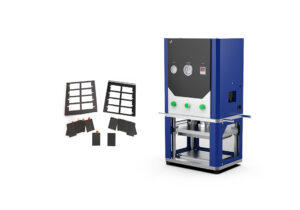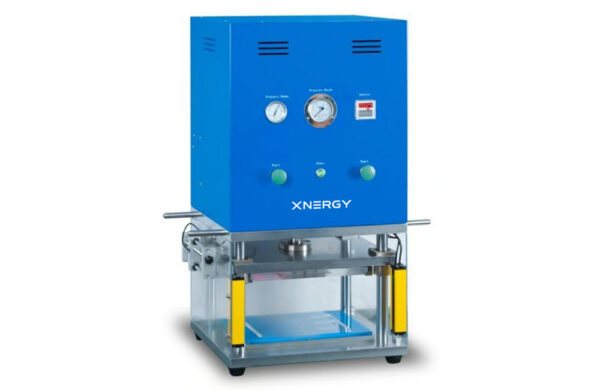
Semi-Automatic Electrode Die-Cutting Machine XN-PDC-350
SKU: XN-PDC-350
Semi-Automatic Electrode Die-Cutting Machine XN-PDC-350 is a benchtop pneumatic-hydraulic die-cutter for high-throughput shaping of large-format lithium-ion battery cathode and anode sheets to custom electrode geometries with integrated tabs. A 5-ton pneumatic-hydraulic booster cylinder delivers 1–8 sheets per stroke (2 standard) at 800–2000 pieces per hour throughput.
Max cut size 320 × 240 mm (with tab) on custom dies, ±0.1 mm precision, infrared positioning, light-curtain + dual-button safety actuation.
Need a bulk order or custom specification? Request a competitive quote today!
Name: Semi-Automatic Electrode Die-Cutting Machine XN-PDC-350
Equipment Type: Benchtop Semi-Automatic Pneumatic-Hydraulic Die-Cutting Machine
Product Code: XN-PDC-350
Brand: Xnergy
Product Introduction:
Semi-Automatic Electrode Die-Cutting Machine XN-PDC-350 is a benchtop pneumatic-hydraulic die-cutter for high-throughput shaping of large-format lithium-ion battery cathode and anode sheets to custom electrode geometries — including pouch- and prismatic-cell shapes with integrated tab cutouts. A 5-ton pneumatic-hydraulic booster cylinder drives the upper die assembly downward, cutting 1 to 8 sheets per stroke (2 sheets standard) depending on die layout, with throughput of 800 to 2000 pieces per hour. Infrared positioning aligns the sheet to the die, and a safety light curtain combined with dual-button actuation protects the operator during high-volume operation.
Working Principle:
Place pre-cut electrode sheets onto the lower die plate. Press both safety-actuation buttons simultaneously. The pneumatic-hydraulic booster cylinder drives the upper die downward, cutting one or more sheets per stroke. Remove the finished parts to complete the cycle.
Key Features:
Pneumatic-hydraulic booster cylinder delivers 5-ton cutting force at adjustable speed
Custom die tooling for any electrode shape — including tab cutouts for pouch and prismatic cells
Maximum cut size 320 × 240 mm (including tab), custom-specified per die
Multi-up dies — 1 to 8 sheets per stroke depending on size (2 standard)
Throughput 800 – 2000 pieces per hour
Four-pillar guide structure for smooth, high-precision vertical motion
±0.1 mm cut precision
Vertical burr ≤ 15 μm; horizontal burr ≤ 20 μm
Long die life — ≥ 30,000 cuts under normal use
Quick and easy die changeover
Infrared sheet-positioning system for accurate sheet-to-die alignment
Safety light curtain at the feed entry combined with dual-button actuation
Cutting force and stroke speed both adjustable
Technical Specifications:
| Parameter | Specification |
|---|---|
| Drive | Pneumatic-hydraulic booster cylinder, 5 T |
| Actuation | Dual-button start (two-hand safety) |
| Positioning | Infrared sheet-to-die alignment |
| Maximum Cut Size | 320 × 240 mm (including tab) — customizable per die |
| Multi-Up Capability | 1 – 8 sheets per stroke depending on die size (2 standard) |
| Throughput | 800 – 2000 pcs/h (lower for single-sheet feed) |
| Cut Precision | ±0.1 mm |
| Vertical Burr | ≤ 15 μm |
| Horizontal Burr | ≤ 20 μm |
| Die Life | ≥ 30,000 cuts (normal use) |
| Die-Cut Stroke | 150 mm |
| Force & Speed Adjustment | Both cutting force and stroke speed adjustable |
| Safety | Safety light curtain at feed entry, dual-button actuation |
| Guide Structure | Four-pillar guide |
| Compressed Air Requirement | 0.5 – 0.8 MPa |
| Power Supply | Configurable according to local electrical standards |
| Rated Power | 0.1 kW |
| Dimensions (L × W × H) | 700 × 440 × 970 mm |
| Weight | 240 kg |
Application Areas:
XN-PDC-350 is suitable for:
Semi-automatic die-cutting of large-format lithium-ion battery cathode and anode sheets to pouch- and prismatic-cell electrode shapes with integrated tabs
Large electrode shape preparation up to 320 × 240 mm
Pilot and small-production electrode shape manufacturing for larger cell formats (e.g., large pouch, prismatic, power-cell electrodes)
R&D workflows scaling toward larger-format cell prototyping
Maintenance:
Clean the equipment regularly with a soft cloth lightly moistened with alcohol
Lubricate moving parts periodically to ensure smooth operation
If the equipment is not used for an extended period, clean the moving surfaces and apply a protective anti-rust coating
Periodically inspect screws, nuts, pins, and other fasteners to prevent loosening
Inspect the die regularly and replace at end of life to maintain burr specification
Safety Notes:
Do not bypass the safety light curtain or dual-button operation
Do not place hands or other body parts in the die work area during operation
Operation should be performed by a single trained operator
Disassembly should only be performed by qualified technicians
Ensure compressed air supply is stable within the specified range before operation
Specifications are provided for reference. Custom die tooling and shapes are specified at order time.
Note: Specifications listed above are typical and for reference only. Actual die-cutting performance depends on electrode sheet thickness, coating composition, die condition, and air-supply stability. XN-PDC-350 is the large-format member of Xnergy’s pneumatic die-cutting line — a 5-ton booster cylinder and 320 × 240 mm cut envelope make it the right choice for large-format pouch cells, power-cell electrodes, and prismatic-cell shapes that exceed the working range of smaller die-cutters. For smaller-format electrodes up to 280 × 180 mm at 3-ton force, the XN-PDC-280 handles the same throughput band (800–2000 pcs/h) at a lower price point and smaller footprint. When the workflow is single-stroke prototyping rather than continuous production — or when die-cutting must be performed inside an inert-atmosphere glovebox — the all-pneumatic, no-electrical XN-PDC-120 is the appropriate alternative. For coin-cell round discs only, the manual XN-HPM-24 is the most compact and economical option. Upstream electrode sheets are typically produced via the Slot-Die Coating System XN-SDC with width slitting on XN-CSER-500 for the wider strip widths matched to PDC-350 dies. For active materials feeding into the workflow, see our Cathode Materials and Anode Materials catalogs.