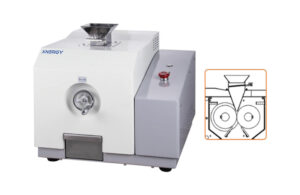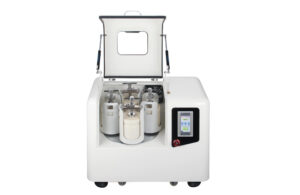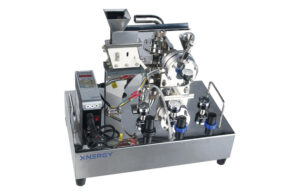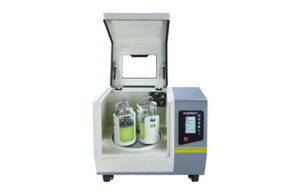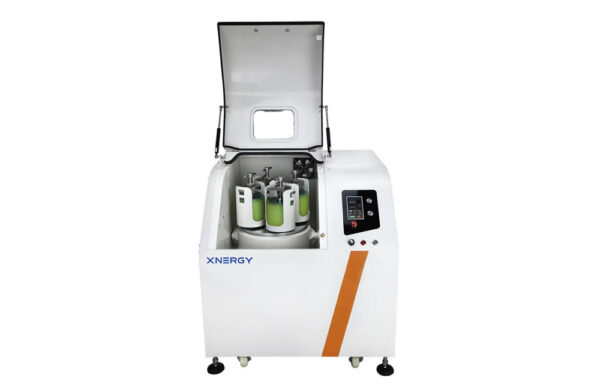
Full Direction Planetary Ball Mill XN-QM-QX Series
SKU: XN-QM-QX
Full Direction Planetary Ball Mill XN-QM-QX Series is a 360° tilting planetary ball mill that eliminates the dead-zone settling at the jar bottom found in conventional vertical planetary mills. The main planetary disc runs at any angle through a full 360° rotation, so the powder is fully engaged in grinding and mixing — also called a “planetary grinder without dead angle.”
12 models from 0.4 L laboratory to 100 L mass-production, four matched unloading vehicles (XN-XL-40 to XN-XL-100), supports dry/wet/vacuum/inert-atmosphere grinding.
Need a bulk order or custom specification? Request a competitive quote today!
Name: Full Direction Planetary Ball Mill XN-QM-QX Series
Equipment Type: 360° Tilting Full-Direction Planetary Ball Mill with No Dead-Zone Grinding
Product Code: XN-QM-QX
Brand: Xnergy
Product Introduction:
XN-QM-QX Series Full Direction Planetary Ball Mill is an upgrade of the conventional vertical planetary ball mill. The difference: the planetary main disc rotates through a full 360°, or operates at any tilt angle during the run — so the powder is fully engaged in grinding and mixing at all times, with no settling to the jar bottom. For this reason it is also called a “planetary grinder without dead angle,” and is the appropriate choice for materials where bottom settling reduces grinding efficiency or causes batch-to-batch inconsistency. The XN-QM-QX range spans 12 models from 0.4 L laboratory benchtop units up to 100 L production-scale floor units, with four matched unloading vehicles (XN-XL-40 through XN-XL-100) supplied for the mass-production models to discharge ground material into a closed tank with vibratory sieving downstream.
Key Features:
360° full-direction planetary motion — main disc rotates through 360° or operates at any tilt angle
Eliminates dead-zone settling at the jar bottom — powder is engaged in grinding at all times
Four grinding modes — dry, wet, vacuum, and inert (protective) atmosphere
Full 12-model range from 0.4 L laboratory to 100 L mass-production
Matched unloading vehicles (XN-XL-40 to XN-XL-100) for closed-system discharge from mass-production models
Self-locking safety door — opens only when the machine is stopped
PLC + touchscreen control on production models
Programmable grinding time, RPM
Caster wheels on all models for easy repositioning
Power range from 0.9 kW (benchtop) up to 22.5 kW (100 L production)
Production Configuration:
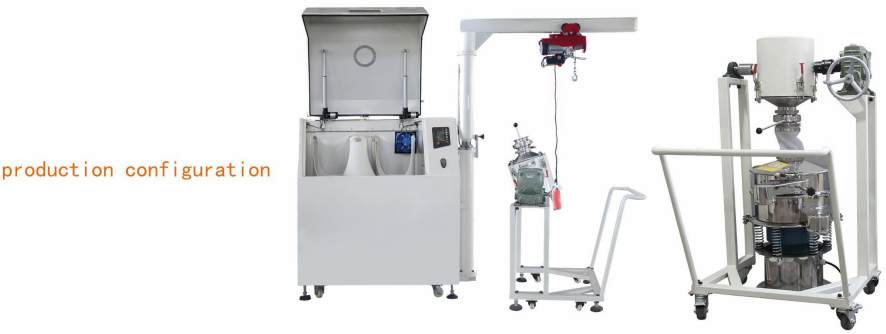
The mass-production models are typically supplied as a three-piece configuration: the planetary ball mill itself, an overhead electric hoist for jar lifting and removal, and a matched XN-XL unloading vehicle with vibratory sieve for closed-system discharge and screening of the ground material.
Laboratory-Scale Models (0.4–12 L):
| Model | Grinding Jar | Vacuum Jar | Sun Wheel | Jar Speed | Power | Weight |
|---|---|---|---|---|---|---|
| XN-QM-QX-0.4L | 50 – 100 mL | 50 mL | 5 – 450 rpm | 10 – 900 rpm | 0.9 kW | 132 kg |
| XN-QM-QX-1L | 50 – 250 mL | 50 – 100 mL | 5 – 450 rpm | 10 – 900 rpm | 0.9 kW | 135 kg |
| XN-QM-QX-2L | 50 – 500 mL | 50 – 250 mL | 5 – 400 rpm | 10 – 800 rpm | 1.2 kW | 206 kg |
| XN-QM-QX-4L | 50 – 1000 mL | 50 – 500 mL | 5 – 400 rpm | 10 – 800 rpm | 1.2 kW | 210 kg |
| XN-QM-QX-8L | 500 – 2000 mL | 500 – 2000 mL | 5 – 320 rpm | 10 – 640 rpm | 3.7 kW | 280 kg |
| XN-QM-QX-12L | 1000 – 3000 mL | 1000 – 3000 mL | 5 – 320 rpm | 10 – 640 rpm | 3.7 kW | 390 kg |
Mass-Production Models (16–100 L):
| Model | Grinding Jar | Vacuum Jar | Sun Wheel | Jar Speed | Power | Weight |
|---|---|---|---|---|---|---|
| XN-QM-QX-16L | 1 – 4 L | 1 – 4 L | 5 – 230 rpm | 10 – 460 rpm | 6.7 kW | 500 kg |
| XN-QM-QX-20L | 1 – 5 L | 1 – 5 L | 5 – 230 rpm | 10 – 460 rpm | 6.7 kW | 614 kg |
| XN-QM-QX-40L | 5 – 10 L | 5 – 10 L | 5 – 220 rpm | 10 – 440 rpm | 11.5 kW | 920 kg |
| XN-QM-QX-60L | 10 – 15 L | 10 – 15 L | 5 – 220 rpm | 10 – 440 rpm | 11.5 kW | 1100 kg |
| XN-QM-QX-80L | 10 – 20 L | 10 – 20 L | 5 – 180 rpm | 10 – 360 rpm | 22.5 kW | 1400 kg |
| XN-QM-QX-100L | 10 – 25 L | 10 – 25 L | 5 – 180 rpm | 10 – 360 rpm | 22.5 kW | 1600 kg |
Matched Unloading Vehicles (for Mass-Production Models):
| Model | Discharge Tank | Discharge Flange |
|---|---|---|
| XN-XL-40 | 10 L | 100 mm |
| XN-XL-60 | 15 L | 100 mm |
| XN-XL-80 | 20 L | 100 mm |
| XN-XL-100 | 25 L | 100 mm |
Laboratory models 0.4 – 4 L use single-phase supply; larger units use three-phase. Power supply is configurable to local electrical standards. Unloading vehicles are matched to the corresponding mass-production mill model.
Operating Modes:
Dry grinding — for dry powder size reduction, mixing, and alloying
Wet grinding — for slurry milling and dispersion
Vacuum grinding — using vacuum jars for oxygen-sensitive materials or de-gassing during grinding
Protective-atmosphere grinding — under inert gas for moisture- and oxygen-sensitive chemistries such as lithium metal, sodium metal, sulfide solid electrolytes, and reactive powders
Application Areas:
XN-QM-QX Series is suitable for:
Lithium-ion and sodium-ion battery active-material development at scale — where dead-zone-free grinding improves batch-to-batch reproducibility
Sulfide and oxide solid-electrolyte preparation requiring complete powder engagement at all times
Nano-powder grinding and dispersion across R&D, pilot, and production scale
Mechanochemical synthesis where full powder utilization (no jar-bottom settling) matters for yield
Scale-up workflows where the same recipe must move from gram-scale to multi-kilogram production with consistent process parameters
Maintenance:
Clean the equipment regularly with a soft cloth lightly moistened with alcohol
Lubricate moving parts periodically to ensure smooth operation
If the equipment is not used for an extended period, clean the moving surfaces and apply a protective anti-rust coating
Periodically inspect screws, nuts, pins, and other fasteners to prevent loosening
Inspect jar seals (especially vacuum jars) before each atmosphere-controlled run
Safety Notes:
Do not open the safety door while the machine is running — the door is interlocked but should not be forced
Operation should be performed by a single trained operator
Disassembly should only be performed by qualified technicians
For vacuum and inert-atmosphere modes, verify jar seal integrity before starting a run
For mass-production models (≥16 L), verify three-phase electrical installation, floor-load capacity, and overhead hoist clearance before commissioning
Specifications are provided for reference and may be adjusted to suit specific process requirements. Grinding jars, grinding media, and matched unloading vehicles are specified at order time according to the target material, process, and production-scale model selected.
Note: Specifications listed above are typical and for reference only. Actual grinding performance depends on input material properties, grinding-media selection, jar-fill ratio, and process parameters. XN-QM-QX Series is the “no dead angle” member of Xnergy’s planetary ball mill range — the 360° tilting motion that distinguishes it solves a specific problem that vertical planetary mills cannot: powder settling at the jar bottom, which reduces effective grinding volume and creates batch-to-batch inconsistency for sticky, dense, or fine-feed materials. The matched XN-XL unloading vehicles supplied with the mass-production models close the loop by providing closed-system discharge with vibratory sieving — important for atmosphere-sensitive chemistries and contamination-sensitive workflows. For users who do not need full-direction motion and prefer the lower price point of a conventional vertical planetary mill, the comprehensive XN-YXQM Series covers the same 0.4 – 100 L range in a vertical configuration. For mechanical alloying and rapid sub-micron grinding at 1600 rpm jar speed, see the XN-MAX1600 Ultra High Energy Ball Mill. For benchtop space-constrained labs at 2 L and below, see the floor-standing XN-ZQM Series or the semi-circular benchtop XN-BQM Series. Milled powders typically proceed to slurry preparation — for laboratory batches use the XN-PVM-500mL or the bladeless XN-PVMC-150mL; for pilot and production batches matching the larger QM-QX mass-production models, use the XN-PVM-5L or XN-PVM-10L planetary vacuum mixers. For active materials commonly milled with this equipment, see our Cathode Materials and Anode Materials ranges (including metallic lithium and sodium metal series).