
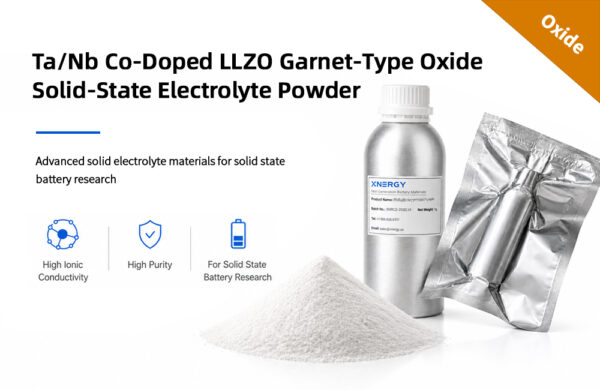
Ta/Nb Co-Doped LLZO Garnet-Type Oxide Solid-State Electrolyte Powder
SKU: XN-LLZO-TANB
Ta/Nb Co-Doped LLZO Garnet-Type Oxide Solid-State Electrolyte Powder is a white garnet-type oxide solid electrolyte powder doped with tantalum and niobium (Ta/Nb). Confirmed inquiry grades: 300 nm / 0.3 µm, 500 nm / 0.5 µm, 1 µm, 5 µm, 10 µm.
Need a bulk order or custom specification? Request a competitive quote today!
Name: Ta/Nb Co-Doped LLZO Garnet-Type Oxide Solid-State Electrolyte Powder
Material Type: Garnet-Type Oxide Solid-State Electrolyte Powder
Product Code: XN-LLZO-TANB
Dopant System: tantalum and niobium (Ta/Nb)
Chemical Formula: Ta/Nb co-doped LLZO; exact stoichiometry and Ta:Nb ratio are customizable and not fixed
Brand: Xnergy
Product Introduction:
This LLZO family is a garnet-type oxide solid electrolyte doped with tantalum and niobium (Ta/Nb) for all-solid-state lithium battery, lithium-metal battery, ceramic electrolyte, and composite electrolyte research. The family uses the confirmed GX size/test framework, with the dedicated Ta 5 µm file taking priority for that grade where applicable.
Core Features:
- White homogeneous garnet-type LLZO powder
- Main phase referenced to PDF#80-0457
- Multiple particle-size grades supplied as inquiry options, not variations
- Per-grade D50, pH, moisture and pellet conductivity values preserved
- Pellet conductivity tested by EIS at 25 ± 2 °C
- Quote-only supply with custom specification discussion
Particle-Size and Test Matrix:
| Inquiry Grade | D50 Basis | D50 Specification | Typical D50 | Secondary-Particle D50 | pH Limit / Typical | Moisture Limit / Typical | Pellet Ionic Conductivity Spec / Typical | Evidence |
|---|---|---|---|---|---|---|---|---|
| 300 nm / 0.3 µm | Primary particles | 0.30 ± 0.06 µm | 0.31 µm | approximately 7 µm | ≤12.5 / 11.5 | ≤0.50 wt% / 0.20 wt% | 0.80 ± 0.10 mS/cm / 0.80 mS/cm | Shared GX framework confirmed for this family |
| 500 nm / 0.5 µm | Primary particles | 0.50 ± 0.10 µm | 0.55 µm | approximately 5 µm | ≤12.5 / 12.0 | ≤0.50 wt% / 0.20 wt% | 0.80 ± 0.10 mS/cm / 0.80 mS/cm | Shared GX framework confirmed for this family |
| 1 µm | Bulk powder | 1.0 ± 0.2 µm | 1.0 µm | Not stated | ≤12.5 / 11.2 | ≤0.20 wt% / 0.17 wt% | 0.80 ± 0.10 mS/cm / 0.73 mS/cm | Shared GX framework confirmed for this family |
| 5 µm | Bulk powder | 5.0 ± 1.0 µm | 4.7 µm | Not stated | ≤12.5 / 12.0 | ≤0.20 wt% / 0.10 wt% | 0.80 ± 0.10 mS/cm / 0.80 mS/cm | Shared GX framework confirmed for this family |
| 10 µm | Bulk powder | 10.0 ± 2.0 µm | 10.6 µm | Not stated | ≤12.5 / 12.1 | ≤0.20 wt% / 0.10 wt% | 0.80 ± 0.10 mS/cm / 0.80 mS/cm | Shared GX framework confirmed for this family |
Evidence scope: Current particle-size and test values use the GX shared framework confirmed by technical staff. The GX files do not establish a fixed dopant fraction.
Formula note: The exact Li-Zr-Ta-Nb stoichiometry and Ta:Nb ratio are not fixed in the supplied evidence and will not be inferred.
Applications:
- All-solid-state lithium battery electrolyte research
- Lithium-metal battery and garnet-electrolyte studies
- Ceramic pellet preparation and sintering development
- Polymer-ceramic composite electrolyte formulation
- Cathode-composite and interfacial engineering research
Note: Ionic conductivity values refer to ceramic pellets measured by EIS at 25 ± 2 °C; they are not direct powder measurements. The powder is moisture-sensitive. Keep sealed and dry, and vacuum-dry before use when required by the process. Actual performance depends on dispersion, pellet formation, sintering, density, electrode interfaces, and test method. Explore the Oxide category and Solid-State Electrolytes.
Related products
-
LATP NASICON-Type Oxide Solid-State Electrolyte (Li₁.₅Al₀.₅Ti₁.₅(PO₄)₃)
Free Shipping Price range: $318.00 through $398.00Select options This product has multiple variants. The options may be chosen on the product page -
Ga-Doped High-Conductivity LLZO Garnet-Type Oxide Solid-State Electrolyte Powder (Li₇La₃Zr₂₋ₓGaₓO₁₂)
-
LAGP Oxide Solid Electrolyte Pellet XN-LAGP-PE
-
NASICON NZSPO Powder for Sodium-Ion Solid-State Electrolytes