
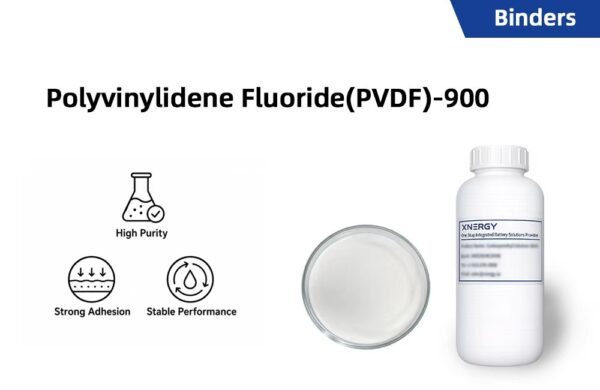
Polyvinylidene Fluoride(PVDF)-900
SKU: XN-BD-PVDF900
Free Shipping$410.26
Arkema KYNAR HSV 900 PVDF Binder — polyvinylidene fluoride (PVDF) homopolymer from Arkema, produced via emulsion polymerization. Specific gravity 1.77–1.79. Melt viscosity 4,450–5,450 Pa·s (230 °C, 100 sec⁻¹). Melting temperature 162–172 °C. NMP-soluble. Available in 1 kg packaging.
Need a bulk order? Request a competitive quote today!
Name: Arkema KYNAR HSV 900 PVDF Binder for Lithium-Ion Batteries
Manufacturer: Arkema
Brand: KYNAR®
Product Code: XN-BD-PVDF900
Product Introduction:
Arkema KYNAR HSV 900 is a polyvinylidene fluoride (PVDF) homopolymer manufactured by Arkema under the KYNAR® brand via emulsion polymerization. The product is supplied as a fine white powder for use in lithium-ion battery binder applications. KYNAR HSV 900 is supplied with the following specifications: specific gravity 1.77–1.79, melt viscosity 4,450–5,450 Pa·s (at 230 °C, 100 sec⁻¹), melting temperature 162–172 °C, tensile yield strength 40–55 MPa, Shore D hardness 76–80. Available in 1 kg packaging.
Key Features:
Arkema KYNAR® HSV 900 — PVDF homopolymer, emulsion polymerization
Specific gravity 1.77–1.79; melt viscosity 4,450–5,450 Pa·s (230 °C, 100 sec⁻¹)
Melting temperature 162–172 °C; tensile yield strength 40–55 MPa; Shore D hardness 76–80
NMP-soluble — standard binder for wet-process cathode electrode slurry formulations
Manufacturer: Arkema (KYNAR® brand); 1 kg packaging
Application:
Arkema KYNAR HSV 900 is used in lithium-ion battery binder applications where PVDF is the binder system. PVDF is dissolved in NMP (N-methyl-2-pyrrolidone) for use in standard wet-process electrode coating workflows.
Physical & Mechanical Properties:
| Property | Method | Conditions | Value |
|---|---|---|---|
| Specific Gravity | D792 | — | 1.77 – 1.79 |
| Melt Viscosity (Pa·s) | D3835 | 230 °C, 100 sec⁻¹ | 4,450 – 5,450 |
| Melting Temperature (°C) | D3418 | — | 162 – 172 |
| Tensile Yield Strength (MPa) | D638 | — | 40 – 55 |
| Tensile Break Strength (MPa) | D638 | — | 34 – 43 |
| Tensile Break Elongation (%) | D638 | — | 50 – 250 |
| Flexural Strength (MPa) | D790 | — | 48 – 62 |
| Flexural Modulus (MPa) | D790 | — | 1,360 – 2,210 |
| Compressive Strength (MPa) | D695 | Notched | 68 – 103 |
| Hardness (Shore D) | D2240 | — | 76 – 80 |
Values measured by Arkema. Typical values for reference; not guaranteed unless otherwise specified.
Other Properties:
| Specification | Typical Value |
|---|---|
| Manufacturer | Arkema |
| Brand | KYNAR® |
| Model | KYNAR HSV 900 |
| Material Type | PVDF homopolymer |
| Polymerization Process | Emulsion polymerization |
| Solvent System | NMP (N-methyl-2-pyrrolidone) |
| Packaging | 1 kg per unit |
Characteristics:
PVDF homopolymer
KYNAR HSV 900 is a polyvinylidene fluoride (PVDF) homopolymer.
Emulsion polymerization
KYNAR HSV 900 is produced via emulsion polymerization.
Melt viscosity 4,450–5,450 Pa·s
The melt viscosity specification (at 230 °C, 100 sec⁻¹) of KYNAR HSV 900 is 4,450–5,450 Pa·s.
Melting temperature 162–172 °C
The melting temperature specification of KYNAR HSV 900 is 162–172 °C.
Specific gravity 1.77–1.79
The specific gravity specification of KYNAR HSV 900 is 1.77–1.79.
Mechanical properties
KYNAR HSV 900 has the following typical mechanical properties: tensile yield strength 40–55 MPa, tensile break strength 34–43 MPa, flexural strength 48–62 MPa, compressive strength 68–103 MPa, Shore D hardness 76–80.
NMP-soluble
KYNAR HSV 900 dissolves in N-methyl-2-pyrrolidone (NMP), the standard solvent for wet-process PVDF cathode slurry preparation.
Arkema KYNAR® brand
Arkema is a global supplier of fluoropolymer chemistries marketed under the KYNAR® brand.
Recommended Use Procedure:
1. Pre-dissolve KYNAR HSV 900 in NMP (N-methyl-2-pyrrolidone) before adding to slurry. Add PVDF powder slowly to vigorously stirred NMP at moderate temperature; avoid forming clumps that resist dissolution. 2. Continue stirring until the PVDF is fully dissolved as a clear viscous solution. 3. Use the dissolved PVDF solution as the binder in standard NMP-based cathode slurry formulations. 4. Filter the final slurry through a fine-mesh filter to remove any aggregates. 5. Coat onto current collector foil using standard coating equipment. 6. Dry the coated electrode at recommended temperatures to remove NMP solvent. 7. Reseal the PVDF container tightly between uses to minimize moisture absorption.
Packaging & Storage:
Arkema KYNAR HSV 900 is supplied in 1 kg packaging, sealed for shipment and storage. Store at room temperature in a dry and sealed environment. PVDF powder is hygroscopic — moisture absorption from humid air will alter the moisture content and may affect dissolution behavior, slurry rheology, and final electrode quality. After opening, reseal the container tightly between uses.
Safety:
For research and industrial laboratory use only. Always wear appropriate PPE (safety glasses, chemical-resistant gloves, lab coat) when handling PVDF binder, NMP solvent, or coated electrodes. NMP is a regulated chemical in many jurisdictions (REACH, OSHA) — handle in a fume hood and follow local regulations on solvent use. Avoid prolonged inhalation of PVDF powder dust during weighing and slurry mixing operations. Do not store near oxidizers, strong acids, or strong bases. Refer to the Arkema Material Safety Data Sheet (MSDS) for complete safety and handling information.
Note: Specifications listed above are typical values provided by Arkema and are for reference only. Actual performance depends on the specific cathode active material, slurry formulation, NMP quality, coating process parameters, and downstream cell manufacturing conditions — consult published literature and Arkema technical bulletins for guidance on optimal PVDF binder formulation protocols. For researchers exploring complete lithium-ion battery binder workflows, see also Xnergy’s related products: Solvay Solef 5130 PVDF, DAICEL CMC 2200, Nippon Paper MAC350HC, Nippon Paper MAC500HC, ZEON SBR BM-430B, ZEON SBR BM-451B, Daikin PTFE Dispersion Binder D-210C, PTFE Binder Powder, and the full Binders category.
| (PVDF)-900 | 1kg |
|---|
Related products
-
Styrene-Butadiene Rubber(SBR)-451B
Free Shipping$359.00Select options This product has multiple variants. The options may be chosen on the product page -
Styrene-Butadiene Rubber(SBR)-430B
Free Shipping$409.00Select options This product has multiple variants. The options may be chosen on the product page -
Daikin PTFE Dispersion Resin F-208 / F-208H
-
Carboxymethyl Cellulose-350HC
Free Shipping$316.67Select options This product has multiple variants. The options may be chosen on the product page