
Laboratory Flow Battery Testing Cell System – YL01
SKU: XN-BM-YL01
Free Shipping$608.00
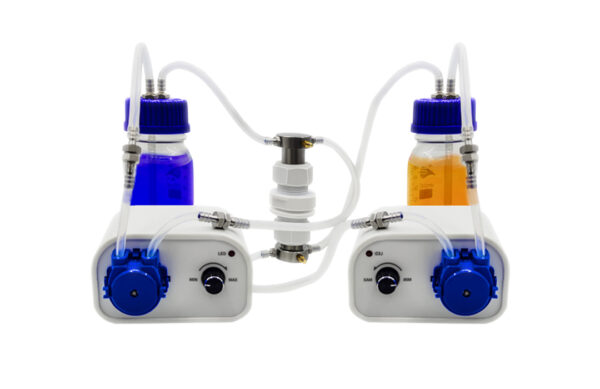
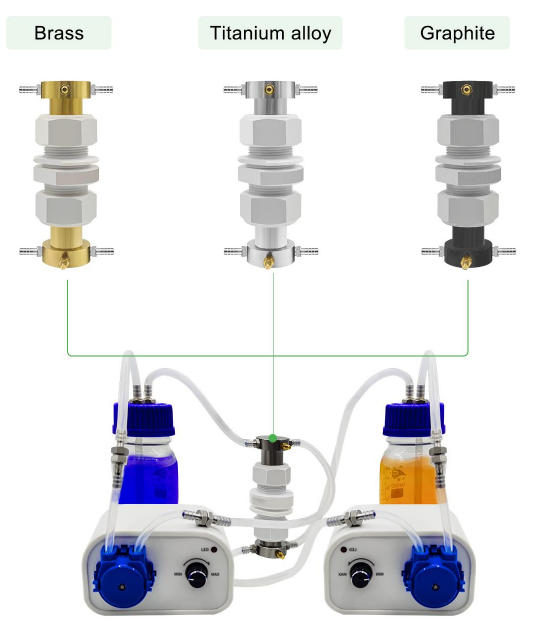
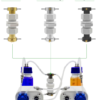
YL01 Laboratory Flow Battery Testing Cell System — flow battery mold set for laboratory research. Mold set includes 2 airtight bottles, 2 peristaltic pumps, and 1 flow battery mold. Built with titanium alloy, PTFE, and copper. Three electrode column options: brass, titanium alloy, graphite. Peristaltic pump flow rate 4–14 ml/min at 12 V. Corrosion-resistant, acid- and alkali-resistant. Use under normal temperature conditions. Can be customized and modified as required.
Need a bulk order or custom specification? Request a competitive quote today!
Name: YL01 Laboratory Flow Battery Testing Cell System
Mold Type: Flow Battery Mold Set (with Airtight Bottles and Peristaltic Pumps)
Product Code: XN-BM-YL01
Description:
The YL01 is a flow battery mold set for laboratory research. The complete YL01 set includes 2 airtight bottles, 2 peristaltic pumps, and 1 flow battery mold. The flow battery mold is constructed from titanium alloy, PTFE, and copper, and ships with a choice of three electrode column materials: brass, titanium alloy, or graphite. Product accessories include silicone hose. Peristaltic pumps deliver a flow rate of 4–14 ml/min at 12 V. The YL01 is corrosion-resistant, acid- and alkali-resistant, and is used under normal temperature conditions. Can be customized and modified as required.
Application:
The YL01 is designed for laboratory flow battery testing and electrochemical research. The flow battery mold set provides a complete testing platform for redox flow battery experiments, including electrolyte circulation through the cell, controlled flow rate via peristaltic pumps, and electrolyte storage in airtight bottles.
Specifications:
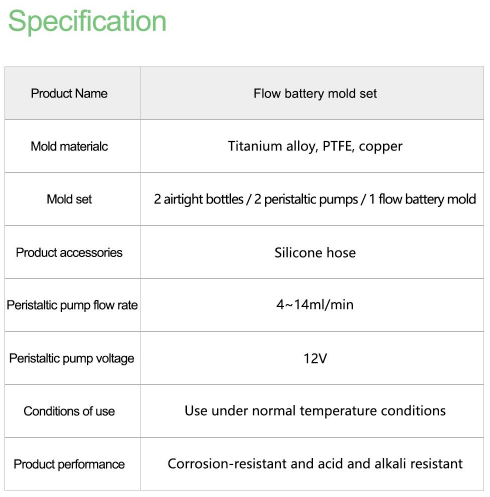
| Parameter | Value |
|---|---|
| Product Type | Flow battery mold set |
| Mold Materials | Titanium alloy, PTFE (polytetrafluoroethylene), copper |
| Mold Set Includes | 2 airtight bottles, 2 peristaltic pumps, 1 flow battery mold |
| Product Accessories | Silicone hose |
| Sealing System | Silicone gaskets between electrode columns (airtight, independent flow on both sides) |
| Peristaltic Pump Flow Rate | 4 – 14 ml/min |
| Peristaltic Pump Voltage | 12 V |
| Conditions of Use | Normal temperature conditions |
| Product Performance | Corrosion-resistant, acid- and alkali-resistant |
| Customization | Available on request |
Values measured by Xnergy. Typical values for reference; not guaranteed unless otherwise specified.
Available Electrode Column Materials:
| Electrode Material | Notes |
|---|---|
| Brass | Brass electrode column option |
| Titanium Alloy | Titanium alloy electrode column option |
| Graphite | Graphite electrode column option |
Characteristics:
Complete flow battery mold set
The YL01 ships as a complete set including 2 airtight bottles, 2 peristaltic pumps, and 1 flow battery mold. Silicone hose is included as an accessory.
Three electrode column material options
The YL01 ships with a choice of three electrode column materials: brass, titanium alloy, or graphite. The selection is made by the customer based on their specific research application.
Silicone gasket sealing for independent flow
Placing silicone gaskets between the electrode columns of the flow battery mold can ensure that both sides are airtight, do not interfere with each other, and flow independently. The gasket allows the flow to follow a circular pattern on both sides of the cell.
Corrosion-resistant construction
The YL01 is constructed from titanium alloy, PTFE, and copper. The combination provides corrosion resistance suitable for laboratory flow battery research.
Acid- and alkali-resistant
The YL01 is acid- and alkali-resistant, suitable for use with acidic and alkaline electrolytes.
Peristaltic pump system (4–14 ml/min, 12 V)
The included peristaltic pumps operate at 12 V with a flow rate of 4–14 ml/min. The peristaltic pump design isolates the pump mechanism from direct electrolyte contact (only the silicone tubing contacts electrolyte).
Recyclable electrolytic cell architecture
Due to the characteristics of fluororubber sealing — including high-temperature resistance, oil resistance, high vacuum resistance, acid and alkali resistance, and resistance to various chemicals — the YL01 supports a recyclable electrolytic cell architecture where electrolyte can be cycled through the system across multiple experiments.
Customization available on request
The YL01 can be customized and modified as required. Contact Xnergy for configuration options that match your specific research requirements.
Recommended Operating Procedure:
1. Clean all wetted-surface components (mold body, electrode columns, silicone gaskets, silicone hoses, airtight bottles) with deionized water followed by isopropyl alcohol; dry thoroughly before each use. 2. Select the appropriate electrode column material (brass, titanium alloy, or graphite) for your research application. 3. Install the silicone gaskets between the electrode columns and assemble the flow battery mold. 4. Connect the silicone hose between the mold inlet/outlet ports, the airtight bottles, and the peristaltic pumps. 5. Fill each airtight bottle with the appropriate electrolyte. 6. Power on the peristaltic pumps (12 V) and adjust the flow rate within the rated 4–14 ml/min range. 7. Connect the cell electrodes to the cycling tester or potentiostat. 8. Operate at normal temperature conditions. 9. After testing, drain the electrolyte safely, rinse all wetted-surface components with deionized water followed by alcohol, dry thoroughly, and store in the original case.
Packaging & Storage:
The YL01 ships as a complete set including the titanium alloy/PTFE/copper flow battery mold, selected electrode columns (brass, titanium alloy, or graphite), 2 airtight bottles, 2 peristaltic pumps with 12 V power supplies, silicone hoses, silicone gaskets, and assembly hardware. Store in a dry environment protected from dust and chemical exposure. After each use, drain electrolyte safely, rinse all wetted-surface components with deionized water and alcohol, and store the system in a clean, dry environment.
Safety:
For research and industrial laboratory use only. Use under normal temperature conditions. Always wear appropriate PPE (safety glasses, chemical-resistant gloves, lab coat) when handling electrolytes — particularly acidic, basic, or other corrosive flow battery electrolytes. Operate the system in a fume hood when working with volatile or toxic electrolytes. Inspect silicone hoses, gaskets, and connections regularly for signs of degradation, leakage, or chemical attack — replace any compromised components before continuing experiments. Power off the peristaltic pumps before any disassembly or component replacement to prevent unintended electrolyte spillage. Refer to the included user manual for complete safety and operating instructions.
Note: Specifications listed above are typical and for reference only. Actual performance and chemical compatibility depend on the specific electrolyte, electrode material, flow rate, and experimental conditions — consult published literature for guidance on specific flow battery testing protocols. For researchers exploring complete flow battery research workflows, see also Xnergy’s related products: YL02 CG Square Flow Battery Mold, YL03 CG Flow Battery Mold, YL04 CG In-Situ Heated Liquid Observation Mold, YT06 Liquid Battery Mold, YT05 Dual-Electrolyte Swagelok Battery Mold, GT14 Sealed Electrochemical Battery Test Bottle, YP01 Circular Tablet Pressing Die, KQ01 Air Battery Mold, GT04 Three-Electrode Solid-State Battery Mold, and YT07 Swagelok Metal-Air Battery Test Cell. Browse the full Battery Mold category for all configurations.
Related products
-
Swagelok-Type Battery Test Cell XN-YT08
Free Shipping Price range: $138.00 through $306.00Select options This product has multiple variants. The options may be chosen on the product page -
In-Situ Raman Battery Test Cell XN-GT06
Free Shipping$268.00 -
Solid-State Battery Assembly Mold XN-GT01
Free Shipping$228.00 -
Square Battery Test Mold XN-GT05
Free Shipping$471.00