
Battery Research Materials: A Complete Buyer’s Guide for Lithium, Sodium, and Solid-State Cells
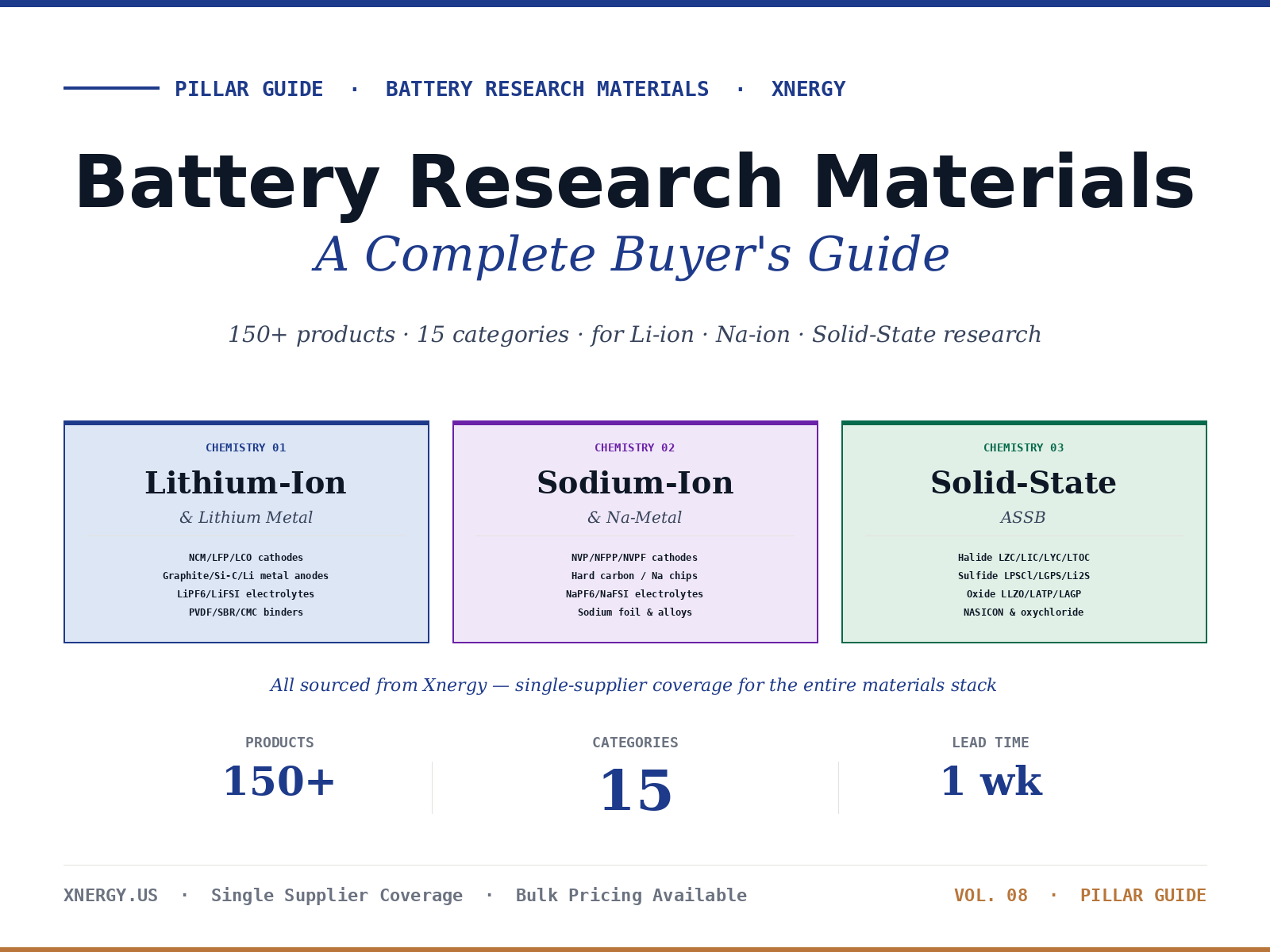
From NCM811 cathodes to LZC halide solid electrolytes to sodium metal chips to dry pouch cells — this guide walks through Xnergy's complete 150+ product battery research materials catalog across 15 categories. Whether you're running lithium-ion, sodium-ion, lithium metal, or all-solid-state battery research, this is the single-supplier overview of what we make and what it's for.
- 01. Single-Supplier Overview
- 02. The 5-Layer Materials Stack
- 03. Cathode Materials
- 04. Anode Materials
- 05. Liquid Electrolytes & Salts
- 06. Solid Electrolytes
- 07. Lithium & Sodium Metal
- 08. Binders & Additives
- 09. Coin Cell Hardware
- 10. Dry Pouch Cells
- 11. 4 Research Paths
- 12. Bulk Pricing & Lead Time
- 13. FAQ
- 14. Related Reading
Xnergy supplies the complete materials stack for battery research across three major chemistries: lithium-ion + lithium metal (NCM/LFP/LCO/NCA cathodes, graphite/Si-C anodes, LiPF6/LiFSI electrolytes, Li metal in 11 forms), sodium-ion (NVP/NFPP/NVPF cathodes, hard carbon, Na chips and foil, NaPF6/NaFSI), and all-solid-state (halide LZC/LIC/LYC/LTOC, sulfide LPSCl/LGPS, oxide LLZO/LATP/LAGP, NASICON, oxychloride). Plus auxiliary materials (binders PVDF/SBR/CMC/PTFE, conductive additives, current collectors), coin cell hardware (15 SKUs from $1.15/case), and dry pouch cells (25+ configurations from $77/cell). Standard items ship within 1 week; bulk pricing available for research labs.
Why Single-Supplier Materials Sourcing Matters
Battery research materials sourcing is a fragmented mess. A typical research lab orders cathodes from one vendor, electrolytes from another, lithium metal from a third, coin cell hardware from a fourth, and pouch cell materials from a fifth. Lead times stack up. Quality control varies between suppliers. When something goes wrong in cell performance, debugging which input caused the problem is harder than the actual experiment.
Xnergy's approach is different. We supply the entire materials stack from a single catalog — 15 product categories covering cathodes, anodes, electrolytes (liquid and solid), binders, conductive additives, dispersants, current collectors, lithium and sodium metal, lithium alloys, Li-collector composite strips, coin cell hardware, and dry pouch cells.
Three practical advantages of single-supplier sourcing:
• Consistent quality control — All materials are batch-tracked from a single supply chain, with documented compatibility between products (the cathode and the electrolyte are designed to work together)
• One PO, one shipment, one timeline — No coordinating delivery dates from 5 different vendors
• Bulk pricing across categories — Volume discounts that don't reset because you switched suppliers
The rest of this guide walks through Xnergy's catalog by category, with specific product links, typical use cases, and pricing where available. For most categories, we link both to the relevant Xnergy materials catalog page and to detailed selection guides where applicable.
The Battery Research Materials Stack: 5 Layers
Every battery cell, regardless of chemistry, is built from a stack of five material layers. Understanding the stack helps map your research scope to the right materials:
-
LAYER 01
Active Materials The chemistry itself — cathode (positive electrode), anode (negative electrode), and the active particles inside each. This is where most novel battery research focuses: developing new cathode chemistries (e.g., high-nickel NCM, sulfur composites), improving anode capacity (e.g., silicon-carbon, lithium metal), or screening sodium-ion replacements.40+ products
-
LAYER 02
Electrolytes The medium for ion transport between electrodes. For Li-ion and Na-ion cells, this is a liquid electrolyte (carbonate solvent + Li/Na salt + additives). For all-solid-state cells, it's a solid electrolyte (halide, sulfide, oxide, or oxychloride powder, pressed into a pellet).50+ products
-
LAYER 03
Auxiliary Materials Binders (PVDF, SBR, CMC, PTFE) hold the active material to the current collector. Conductive additives (carbon black, CNT) provide electron transport within the electrode. Dispersants help process CNT slurries. Current collectors (Cu and Al foil) provide the electrical contact.25+ products
-
LAYER 04
Cell Hardware For coin cell research: the case, gasket, spacer, and spring that hold everything together. For pouch cell research: the laminate pouch, tabs, and welding hardware. For solid-state research: pellet press dies and high-pressure assembly tools.15+ products
-
LAYER 05
Metal Anodes & Specialty Materials Lithium metal (in disc, foil, strip, wire, alloy forms) for Li-metal anode research. Sodium metal (chips, foil) for Na-metal research. Pre-laminated Li-Cu composite strips for direct cell construction. Lithium alloys (Li-Al, Li-Mg, Li-Sn, etc.) for advanced anode research.25+ products
Cathode Materials: Powders & Pre-Coated Sheets
Cathode materials are the largest category in battery research because the cathode is typically the performance-limiting component — it determines cell voltage, energy density, and cycle life. Xnergy supplies cathodes both as powders (for researchers who want to make their own slurries) and as pre-coated electrode sheets (for researchers focused on electrolytes, anodes, or full-cell evaluation).
Lithium-ion cathode powders
The mainstream Li-ion cathode chemistries:
Pre-coated cathode electrode sheets
For researchers who want to skip slurry preparation, casting, and drying:
Sodium-ion cathode materials
Sodium-ion cathodes have diverged into three major families — layered oxides (P2-type), polyanionic phosphates (NVP, NFPP, NVPF), and Prussian blue analogs. Xnergy supplies all three:
For a complete browse of all cathode options, visit the cathode materials catalog or the pre-coated electrode sheet catalog.
Anode Materials: Graphite, Silicon-Carbon, Hard Carbon, Metal Anodes
Anode materials span four major chemistries depending on cell type:
| Anode Type | Best Use | Capacity | Xnergy Products |
|---|---|---|---|
| Graphite | Standard Li-ion cells (commercial baseline) | ~370 mAh/g | MCMB, needle coke, sheets (single + double-sided) |
| Silicon-Carbon | High-energy Li-ion cells | ~1000-1500 mAh/g (composite) | Si/C composite anode sheets |
| Hard Carbon | Sodium-ion cells (defacto standard) | ~300 mAh/g | Kuraray hard carbon sheets |
| Lithium Titanate (LTO) | High-power, long-life Li-ion (low voltage) | ~175 mAh/g | LTO anode sheets |
| Lithium Metal | Li-metal batteries (energy-density frontier) | ~3860 mAh/g | 11 forms (see section 07) |
| Sodium Metal | Na-metal cells (research) | ~1166 mAh/g | Chips + foil |
Graphite anode products
Silicon-carbon and hard carbon
For a complete anode catalog browse, see the anode materials catalog.
Liquid Electrolytes: Salts, Solvents, Additives, and Formulated Mixes
Liquid electrolyte research splits into four sub-categories: salts (LiPF6, LiFSI, NaPF6, etc.), solvents (EC, DMC, DEC, EMC, PC, VC), additives (FEC, VC, DTD, FB, SN, PST), and pre-formulated electrolytes (1M LiPF6 in EC:DMC:DEC, etc.). Xnergy stocks all four with battery-grade purity.
Lithium electrolyte salts
Sodium & potassium electrolyte salts
Carbonate solvents
SEI-forming additives
Pre-formulated electrolytes
For a complete electrolyte browse, see the electrolytes catalog.
Solid Electrolytes: Halide, Sulfide, Oxide, Oxychloride, NASICON
Solid electrolytes are the materials that make all-solid-state batteries (ASSB) possible — they replace the liquid electrolyte and separator with an ionically conductive solid. Xnergy supplies solid electrolytes across all five major chemistry families used in modern ASSB research:
| Family | Conductivity | Best Use | Xnergy Products |
|---|---|---|---|
| Halide | 1-7 mS/cm | High-voltage cathode interface (oxide cathodes) | LZC, Al-LZC, O-LZC, LIC, LYC, LTOC (Li2TaOCl5, LiTaOCl4), LNOC |
| Sulfide | 1-12 mS/cm | High ionic conductivity, Li metal anode | LPSCl argyrodite, LGPS, Li2S precursor |
| Oxychloride | 1-2 mS/cm | Air stability + reasonable conductivity | LZCO (Li2ZrOCl4) |
| Oxide | 0.1-2 mS/cm | High temperature, Li metal compatibility | LLZO, LATP, LAGP, LLZTO |
| NASICON / Sodium SE | 0.5-1 mS/cm | Sodium-ion ASSB | NZSPO, NPSCl, MgO-doped beta-alumina, Na3PS4, W-doped NPS |
Halide solid electrolytes
Sulfide solid electrolytes
Oxide solid electrolytes (LLZO, LATP, LAGP)
Sodium solid electrolytes
For deeper analysis of solid electrolyte selection, see our existing guides: LZC Halide Family Guide, LTOC Selection Guide, LIC Guide, and Sodium ASSB Materials Guide. Or browse the full solid electrolytes catalog.
Lithium & Sodium Metal: Discs, Foils, Strips, Wires, Alloys
Metal anodes — lithium and sodium — are the energy-density frontier in battery research. Lithium metal anodes deliver roughly 10× the gravimetric capacity of graphite (3860 vs 370 mAh/g), making them essential for next-generation high-energy-density cells. Sodium metal serves the equivalent role for sodium-ion research. Both are highly air-reactive, with reactivity scaling roughly as Na > Li, and require careful handling and packaging that protects against atmospheric moisture and oxygen at every step from manufacture through use.
Beyond the chemistry, the practical reality of metal anode research is that form factor matters as much as purity. A lithium disc in a coin cell sees different mechanical conditions than a lithium foil in a pouch cell, and the same chemistry behaves very differently in each context. Xnergy's lithium metal catalog reflects this — we supply 11 distinct lithium metal product forms covering everything from discs for half cells to ultra-thin foils for high-energy-density designs to alloy strips for advanced anode architectures.
Lithium metal product family (11 forms)
The full lithium metal catalog covers every form factor used in modern battery research:
Lithium alloys for advanced anode research
Pure Li metal anodes have known issues that researchers have been wrestling with for decades: dendrite growth during cycling that eventually short-circuits the cell, parasitic side reactions with the electrolyte that consume both Li and electrolyte, and soft mechanical properties that complicate handling. Lithium alloys address these issues by trading a fraction of the gravimetric capacity for substantial gains in cycling stability and mechanical handling.
The most common lithium alloy systems in research are Li-Al (improved mechanical strength and reduced dendrite formation), Li-Mg (suppressed dendrite growth via solid-solution strengthening), Li-Sn (alternative anode chemistry with high theoretical capacity), and Li-B (stable plating-stripping behavior). Xnergy supplies all of these as discs and strips, plus custom multi-element alloys for specialized research:
Li-Collector composite strips
For researchers who want a pre-laminated lithium-on-current-collector for direct cell assembly — bypassing the in-house lamination step that often introduces variability — Xnergy supplies three composite strip products:
Sodium metal products
For sodium-ion battery research, Xnergy supplies pre-cut sodium chips (the most convenient form for coin cell research, with diameter pre-matched to standard CR2032 internal dimensions) and sodium foil rolls (for pouch cell research and custom cell architectures). All sodium metal ships in our 4-layer protective packaging system that maintains shelf life from days to months even after international shipping:
For more on sodium metal selection — chip vs foil decision matrix, packaging considerations, and global supply — see our Sodium Metal Foil & Chip Selection Guide. Browse the full catalogs: Metallic Lithium Series, Sodium Metal Materials, Lithium Alloys, Li-Collector Composite Strips.
Binders, Conductive Additives, Dispersants & Current Collectors
Auxiliary materials don't get the spotlight in battery research, but they determine whether your novel chemistry actually works in a cell. Bad binder choice means electrode delamination during cycling. Insufficient conductive carbon means high cell resistance and poor rate capability. Wrong dispersant means poor slurry rheology, inhomogeneous coating, and irreproducible electrode loading. Most published battery papers spend 2 sentences on auxiliary materials and 20 paragraphs on the active material — but in the lab, getting auxiliaries right is what determines whether a measurement is worth publishing in the first place.
Binders
Three binder families cover most battery research applications, each with distinct solvent compatibility, processing characteristics, and chemistry compatibility:
| Binder Type | Solvent | Best Use |
|---|---|---|
| PVDF | NMP (organic) | Standard cathode binder, all Li-ion chemistries |
| SBR + CMC | Water (aqueous) | Anode binder for graphite, Si/C; greener processing |
| PTFE | Aqueous dispersion | Dry electrode processing, supercapacitors, fuel cells |
The binder selection is rarely "best in absolute terms" — it's "best for your specific electrode system." PVDF is the universal default for cathodes because it dissolves cleanly in NMP and produces robust, long-cycling electrodes with most cathode chemistries. SBR-CMC is increasingly replacing PVDF for anodes (and some cathodes) because aqueous processing is cheaper, greener, and avoids the NMP recovery infrastructure. PTFE is the dry-processing future — cells can be assembled without solvents at all, dramatically simplifying manufacturing and improving sustainability metrics.
For SBR binder selection (water-based vs cold-weather variants), see our SBR-451B Selection Guide and SBR-430B Cold-Weather Guide.
Conductive additives
Carbon additives provide electron transport pathways within the electrode active layer. Carbon black (C65, C02) is the standard — cheap, well-characterized, and compatible with most slurry systems. Carbon nanotubes (CNT) offer higher electrical conductivity at much lower loading (1-2 wt% CNT can replace 5-8 wt% carbon black), but require dispersant assistance because they aggregate in pristine form. The trade-off: CNT-based electrodes have higher energy density (less inactive carbon mass) but more complex slurry processing.
Dispersants for CNT processing
CNTs aggregate easily and need dispersants to form stable slurries. The choice of dispersant depends on the slurry solvent system:
Current collectors
Aluminum foil for cathodes, copper foil for anodes — with carbon-primer-coated variants for improved adhesion and reduced contact resistance. The primer coating is a thin layer of conductive carbon between the metal foil and the active layer; it improves both electron transfer (lower resistance) and mechanical adhesion (better cycle life). For most chemistries, primer-coated foil is recommended over uncoated; the cost difference is modest and the performance difference can be significant:
Browse the full catalogs: Binders, Conductive Additives, Dispersants, Current Collectors.
Coin Cell Hardware: Cases, Spacers, Springs & Specialty
Coin cell hardware is the most-used cell format in battery research because it provides the right balance of statistical power (you can make 50-100 cells per day for replicates), low material consumption (50-200 mg active material per cell), reproducible geometry (the case dimensions are tightly controlled by manufacture), and broad cycler compatibility (every battery cycler supports CR2032). Xnergy supplies the complete coin cell hardware range with current sale pricing on standard items and quote-based pricing for high-voltage and specialty hardware.
Standard 304SS hardware (sale-priced)
Specialty hardware: Al-Clad & In Situ XRD
Al-clad cases are required for high-voltage cathode research above 4.3V vs Li/Li+ — standard 304SS cases corrode under these conditions and contaminate the electrolyte. Kapton-window cases enable in situ X-ray diffraction during cycling, which has revolutionized battery research over the past decade by letting researchers watch cathode lattice evolution in real time:
For complete coin cell hardware selection guidance — including how to choose between CR2032/2025/2016 and when to switch to Al-Clad — see our Coin Cell Hardware Buyer's Guide. Browse the full coin cells catalog. For step-by-step coin cell assembly, see How to Make a Coin Cell tutorial.
Dry Pouch Cells: Pre-Assembled, Electrolyte-Ready
Dry pouch cells are fully assembled pouch cells shipped without electrolyte injection. The user fills electrolyte at their own facility before cycling, which is one of the most useful product categories Xnergy offers and arguably one of the things that distinguishes us from generic materials suppliers. Two practical benefits:
• Extended shelf life — The electrochemistry is dormant until electrolyte is added, so cells can be stockpiled for months or even years without performance degradation. This is impossible with pre-filled cells, which begin self-discharging and developing SEI the moment electrolyte contacts the electrodes
• Electrolyte customization — Researchers can test different electrolyte formulations in identical baseline cells, isolating the electrolyte's contribution to performance. This is a control experiment that's effectively impossible with pre-filled cells, and it's the right way to publish electrolyte additive research
Xnergy's dry pouch cell catalog covers Li-ion, Li metal, and sodium-ion chemistries with 25+ configurations. Pricing ranges from $77/cell (LFP/graphite anode-free, the most affordable entry point) to $445/cell (high-energy NCM90/Li metal, frontier energy density chemistry).
Lithium-ion dry pouch cells (graphite or Si/C anode)
Anode-free dry pouch cells
Anode-free designs let researchers study lithium plating-stripping behavior directly on the current collector — a frontier for next-gen Li-metal-style cells. Without a pre-deposited Li metal anode, all the lithium that participates in cycling has to come from the cathode, which puts severe demands on the electrolyte and SEI chemistry. This is the chemistry where breakthrough cycle life results would have transformative impact:
Lithium metal dry pouch cells (high-energy frontier)
Lithium metal pouch cells are the highest-energy-density cell format currently producible. Pairing high-Ni cathodes (NCM811, NCM90) with Li metal anodes pushes pouch cell energy density toward 400 Wh/kg, well above the 280-300 Wh/kg ceiling of conventional Li-ion. The challenges are well-known: Li dendrite growth, electrolyte consumption, and capacity fade over hundreds of cycles. These are the cells where novel electrolyte additives and protective interphase research has the highest impact:
Sodium-ion dry pouch cells
Sodium-ion dry pouch cells are the fastest-growing category in our catalog as commercial Na-ion production scales up in 2025-2026. Both polyanionic (NVP, NFPP) and layered oxide (P2) cathode chemistries are available, paired with Kuraray hard carbon anodes (the de facto standard) or sodium metal:
For complete dry pouch cell catalog, see Dry Pouch Cell catalog.
4 Research Paths: Materials Roadmap by Chemistry
If you're starting a new battery research project and want a quick chemistry-by-chemistry materials roadmap, the four cards below summarize what to order from Xnergy. Each path represents a typical research scope — conventional lithium-ion, sodium-ion, all-solid-state, and lithium metal — with the materials list optimized for that scope's requirements:
Standard Li-Ion Research
Cathode + graphite anode + liquid electrolyte. Best for new electrode materials, electrolyte additives, or full-cell evaluation.
- NCM/LFP/LCO cathode (powder or pre-coated sheet)
- Graphite anode (or Si/C for high-energy)
- 1M LiPF6 in EC:DMC:DEC electrolyte
- PVDF binder + carbon black
- 304SS CR2032 case set + 0.5mm spacer
Sodium-Ion Battery Research
Sodium-ion cathode + hard carbon anode (or sodium metal for half cells) + Na electrolyte. The fastest-growing chemistry in 2025+.
- NVP / NFPP / NVPF / P2 cathode
- Kuraray hard carbon anode (or Na chip)
- 1M NaPF6 in EC:DMC electrolyte
- SBR-CMC binder for hard carbon
- Glass fiber separator + standard hardware
Solid-State Battery Research
Solid electrolyte + composite cathode + Li metal anode. The energy-density frontier with no liquid electrolyte.
- Halide SE (LZC family) or sulfide (LPSCl)
- Composite cathode: NCM + SE + carbon
- Li metal disc anode (or Li-In alloy)
- Al-Clad CR2032 case (high voltage)
- No liquid electrolyte, no separator
Lithium Metal Battery Research
Cathode + Li metal anode + liquid electrolyte (or hybrid). Highest energy density, ongoing dendrite research.
- NCM811 / NCM90 cathode (high-energy)
- Li metal disc 15.6mm (or microporous foil)
- 1M LiPF6 in EC:DEC + 5% FEC additive
- Glass fiber separator (better for Li metal)
- SEM transfer chamber for post-mortem
Bulk Pricing & Lead Time for Research Programs
Xnergy supports both small-scale academic research (single PIs running 50–100 cells per month) and production-scale industrial R&D programs (research labs running cell-level screening at 10,000+ cells per year). Pricing scales with order volume; standard items ship within 1 week. The pricing tiers below summarize how we structure orders by volume and customization level:
Lead time tiers
| Order Type | Lead Time | Typical Use |
|---|---|---|
| Standard items in stock | 1 week | Coin cell hardware, common cathodes/anodes, standard electrolyte salts, standard solid electrolytes (LZC, LIC, LPSCl) |
| Custom-spec items | 4-6 weeks | Custom-shaped Li metal, custom-doped solid electrolytes, custom electrode coatings, custom alloy compositions |
| Bulk orders | Negotiated | 1000+ pieces of coin cell hardware, kg-scale electrolyte salts, large-scale electrode sheet rolls |
| Long-term contracts | Reserved inventory | Production research with 50,000+ pcs/year volume; quarterly pricing locks |
Single Supplier for the Full Battery Research Materials Stack
One PO covers your active materials, electrolytes (liquid and solid), binders and additives, current collectors, coin cell hardware, and even dry pouch cells. Tell us what you're researching; we'll give you a materials list, lead time, and bulk pricing within one business day.
- 40+ cathodes (NCM, LFP, LCO, NCA, sodium-ion variants)
- 15+ anodes (graphite, Si/C, hard carbon, Li/Na metal)
- 30+ liquid electrolyte components (salts, solvents, additives)
- 22+ solid electrolytes (halide, sulfide, oxide, oxychloride)
- 11 lithium metal forms + 8 lithium alloys
- 15+ coin cell hardware items + Kapton-window specialty
- 25+ dry pouch cell configurations
- Bulk pricing & long-term supply agreements
sales@xnergy.us · 1-512-270-1908
Research applications supported
Frequently Asked Questions
What materials do I need for battery research?
Battery research requires materials across five layers: (1) active materials — cathode powders (NCM, LFP, LCO, NCA, LMO, sodium-ion variants like NVP/NFPP) and anode materials (graphite, Si/C composites, hard carbon for sodium-ion, lithium titanate, lithium and sodium metal); (2) electrolytes — either liquid (carbonate solvents with LiPF6, LiFSI, or sodium analogs) or solid (halide, sulfide, oxide, or oxychloride electrolytes for solid-state cells); (3) auxiliary materials — binders (PVDF, SBR, CMC, PTFE), conductive additives (carbon black, CNT slurries), dispersants, and current collectors (Cu and Al foil); (4) cell hardware — coin cell cases, spacers, springs, and pouch cell components; (5) characterization tools — SEM transfer chambers, battery cyclers, electrochemical workstations. Xnergy supplies all five layers from a single catalog.
Where can I buy lithium-ion battery cathode materials for research?
Xnergy supplies a complete range of lithium-ion battery cathode materials for research, both as powders and pre-coated electrode sheets. Available cathodes include NCM (NCM111, 523, 622, 811, 90 high-nickel), NCA (LiNi0.8Co0.15Al0.05O2 and LiNi0.88Co0.09Al0.03O2 high-nickel variants), LCO (LiCoO2), LFP (LiFePO4), LMO (LiMn2O4), LMFP, LRMO, LNMO (high-voltage 5V spinel), and sulfur-based cathodes (SPAN, SSPN composite for Li-S). Sheet variants are pre-coated on aluminum foil at multiple loadings, single or double-sided. Powders typically ship at 500g per package; sheets ship at 1m roll length with custom widths.
What sodium-ion battery materials does Xnergy supply?
Xnergy's sodium-ion battery materials cover the full chemistry: cathodes (NVP, NFPP, NVPF, P2 layered oxide, Fe-Mn-Co-Ni-V multi-element), anodes (Kuraray hard carbon sheets, sodium metal chips at 15.6mm × 0.45mm, sodium metal foil at 70-500µm thickness), electrolytes (NaPF6, NaFSI, NaTFSI salts and 1M NaPF6 in EC:DMC formulated electrolyte), and solid electrolytes (NASICON NZSPO, NPSCl sulfide, MgO-doped beta-alumina, W-doped NPS, Na3PS4). Dry pouch cell options include P2 anode-free, NVP/NFPP cathode + hard carbon anode, and sodium metal pouch designs.
What solid electrolytes are available for all-solid-state battery research?
Xnergy supplies solid electrolytes across all four major chemistry families. Halide: LZC (Li2ZrCl6) baseline plus Al-doped LZC and O-doped LZC variants, LIC (Li3InCl6), LYC (Li3YCl6), LTOC (Li2TaOCl5 and LiTaOCl4), LNOC (LiNbOCl4), and LZCO (Li2ZrOCl4 oxychloride). Sulfide: LPSCl argyrodite, LGPS (Li10GeP2S12), and high-purity Li2S precursor. Oxide: LLZO (Li7La3Zr2O12) garnet, LATP (NASICON-type), plus oxide ceramics (LLZO/LLZTO/LATP/LAGP). Sodium-ion solid electrolytes: NASICON NZSPO, NPSCl, W-doped NPS, MgO-doped beta-alumina, Na3PS4. All available as research-grade powder; conductivity values from 0.5 to 7 mS/cm depending on chemistry.
Does Xnergy supply lithium metal for battery research?
Yes. Xnergy supplies battery-grade lithium metal in 11 forms: high-purity discs (≥99.9%, custom diameters), strips (standard, ultra-narrow, ultra-wide), wire, ingots (99.95-99.99%), granules, ultra-thin foil (down to 5µm), microporous foil (5µm with stripped or intermittent patterning), Li-Cu composite double-sided laminated foil for lithium metal batteries, and custom Li alloys (Li-Al, Li-Mg, Li-In, Li-Sn, multi-element systems). Battery-grade lithium carbonate (Li2CO3) powder is also available as a precursor. All lithium metal products ship in protective packaging compatible with glovebox antechamber transfer.
What is the lead time for battery research materials orders?
Standard Xnergy materials ship within 1 week of order confirmation. This applies to coin cell hardware, standard cathode and anode powders, common solid electrolytes (LZC, LIC, LTOC, LPSCl), and pre-cut metal anodes (sodium chips, lithium discs). Custom-spec items (custom-doped solid electrolytes, custom electrode coatings, custom-shaped lithium metal, custom alloy compositions) typically ship within 4-6 weeks. Bulk orders (1000+ pieces of coin cell hardware, kg-scale electrolyte salts) may have negotiated lead times. For production research orders requiring sustained supply, long-term contracts with reserved inventory and rapid-delivery options are available.
Can I get pre-coated electrode sheets instead of mixing my own slurry?
Yes. Xnergy supplies pre-coated electrode sheets for most common chemistries — useful for researchers focused on electrolyte studies, cell-level performance evaluation, or anyone who wants to bypass the slurry preparation and casting workflow. Available cathodes include LFP, LCO, LMO, NCM (111, 523, 622, 811), NCM90 high-nickel, NCA, LMFP, LNMO, NVP, NFPP, P2, NVPF, sodium-ion polyanionic, SPAN for Li-S. Available anodes include graphite (single and double-sided coating, multiple loadings), silicon-carbon composite, Kuraray hard carbon for sodium-ion, LTO. Sheets are coated on Al or Cu current collector foil at multiple loadings (typically 2-15 mg/cm²) and can be supplied as 1m rolls or as pre-punched discs (Ø13mm, Ø15mm, custom). Some products are also available with carbon-coated current collector foils.
What is a dry pouch cell and how is it different from a regular pouch cell?
A dry pouch cell is a fully assembled pouch cell shipped without electrolyte injection — the user fills electrolyte at their own facility before cycling. This is useful for two main reasons: (1) it dramatically extends shelf life because the electrochemistry is dormant until electrolyte is added, allowing labs to stockpile cells; (2) it lets researchers customize the electrolyte (e.g., test different additives in identical cells), which is impossible with pre-filled cells. Xnergy's dry pouch cell catalog includes 25+ configurations covering Li-ion (NCM811/graphite, NCM90/Si-C, LFP/graphite, LCO/graphite, anode-free), Li metal (NCM811/Li, NCM90/Li, LCO/Li, LFP/Li, NCM523/Li), and sodium-ion (P2 layered oxide, NVP/hard carbon, NFPP/hard carbon, sodium metal pouch). Pricing ranges from $77/cell (LFP/graphite anode-free) to $445/cell (high-energy NCM90/Li metal).
Does Xnergy supply binders and conductive additives for slurry preparation?
Yes. Binder catalog includes PVDF (PVDF-900 standard, PVDF-5130 high-performance), SBR (SBR-451B and SBR-430B for cold-weather processing), CMC (CMC-2200, 500HC, 350HC for varying solution viscosities), and PTFE (Daikin D-210C dispersion, PTFE binder powder). Conductive additive catalog includes Super C65-equivalent carbon black (C02), single-walled CNT slurries (water-based), multi-walled CNT slurries (water-based), thin-walled CNT slurries (N05), and general carbon nanotube slurries. Specialized dispersants for CNT processing in aqueous, alcohol, NMP, and hydrocarbon solvents are also available. All binders and conductive additives are battery-grade and ship at standard 500g packages.
Can Xnergy support production-scale battery research programs?
Yes. Xnergy supports both small-scale academic research (single PIs running 50-100 cells per month) and production-scale industrial R&D programs (research labs running cell-level screening at 10,000+ cells per year). For production-aligned research, we offer: (1) tiered bulk pricing for orders of 1,000-50,000+ units with reserved inventory, (2) long-term supply agreements with quarterly pricing locks, (3) custom packaging and labeling for integration into automated workflows, (4) custom material specifications (custom-shaped lithium discs, custom-doped electrolytes, custom electrode coatings), (5) priority shipping for time-sensitive research milestones. Contact sales@xnergy.us with your projected annual volume and material specifications for a custom quote.
Deeper Selection Guides for Specific Materials
This pillar guide covers the complete catalog at high level. For deeper analysis on specific material families, see our detailed selection guides:
One supplier for the entire battery research workflow
Battery research moves fast, and supply chain friction slows it down. Xnergy's catalog is built for researchers who want to focus on the chemistry, not the logistics — 150+ materials in 15 categories, single-PO ordering, 1-week standard lead time, and bulk pricing for production-scale programs. Whether you're testing a new cathode formulation, evaluating an electrolyte additive, screening solid electrolytes, or building lithium metal cells, the materials are here.